
New to exercise? Here Are Some Tips to Get Started!

We all know that exercise plays a big role in achieving good health and a high quality of life. However, If you are brand new to exercise, it can be daunting with so much information out there. Many questions can come to mind. Where do I start? What does aerobic exercise mean? How do I know what resistance training exercises to get started with? What intensity level is most suitable for me? Here are some tips and information that may be helpful!
Intensity level
Depending on the intensity, activities can range from light to vigorous. For example, a brisk walk is categorized differently from a sprint workout. As a general rule, a person doing a moderate-intensity aerobic exercise will still have the ability to talk whilst doing the activity.
Heart rate is also a good way to measure and monitor intensity. Smart watch technology makes this fairly easy nowadays! However, it is important to bear in mind that some pathologies or medication can change heart rate response to exercise. nn
Rate of Perceived exertion (RPE)
RPE is a simple way to help monitor your intensity of exercise. There are ten levels in total that describe the difficulty of that particular activity.
-
- 1 – Very light activity (anything other than complete rest
-
- 2 to 3 –Light activity. Can maintain for hours with light and easy breathing and can carry a conversation
-
- 4 to 6 – Moderate activity. Can maintain for hours with heavier breath but still maintain short conversation
-
- 7 to 8 – Vigorous activity. On the verge of becoming uncomfortable.
-
- 9 – Very hard activity. Feelings of difficulty maintaining activity
-
- 10 – Max effort activity. Feels impossible to keep going
As a beginner, it is important to be aware of the difficulty of your exercise activity in order to reduce risk of injury and maintain consistency of your exercise program. It is recommended to start with moderate activity to gain a good foundational fitness capacity before pushing the body with higher intensity activities.
Aerobic training
Exercises that increase your heart rate are known as aerobic or endurance training. Aerobic exercises include running, jogging, cycling, swimming, and cross-country skiing.
These exercises are essential for maintaining good health because of the benefits on the cardiovascular system. Aerobic training can help reduce the risk of cardiovascular diseases such as heart disease by improving heart and blood vessel function. Not only that, aerobic activity has a plethora of health benefits on all physiological systems including hormonal balance, brain health, quality of sleep, managing body composition (weight), strengthening of muscles and joints as well!
Recommended guidelines (ACSM)
According to the ACSM, it is recommended to perform moderate-intensity aerobic exercise for 150 minutes per week or vigorous-intensity aerobic exercise for 75 minutes per week to reap the benefits of aerobic exercise. The ACSM also recommends that a warm-up and cool-down period is included in your routine.
What is Resistance training?
Resistance training involves lifting weights to increase muscular strength by increasing muscle mass and bone density. Exercises are generally done with slightly more equipment, including weights such as dumbbells and kettlebells, bands, and machines. By lifting weights, the body will adapt to the load by breaking down and building up muscle fibres and thus, becoming stronger and more resilient to stressors. It is important to have strength training as a part of your exercise routine to improve overall muscular strength and endurance, mobility, and stability. Achieving functional strength in general is helpful in making the body robust to combat the stressors of daily life and thus reducing risk of injury and falls (particularly important in elderly)!
It is important to have a plan and some guidance as a beginner to strength training. Having a program built for individual needs and capacity will be helpful in reducing risk of injury and appropriate progression/time frame to achieve goals. It is recommended that a full body routine involving functional movements be included in your exercise program. Resistance training has been shown to also be beneficial for people of all ages, therefore it is never too late to start! Muscle soreness, also known as delayed onset muscle soreness (DOMS), likely will also occur. As a general rule, intensity levels that result in 24 to 48 hours of soreness is good!
Recommended guidelines (ACSM)
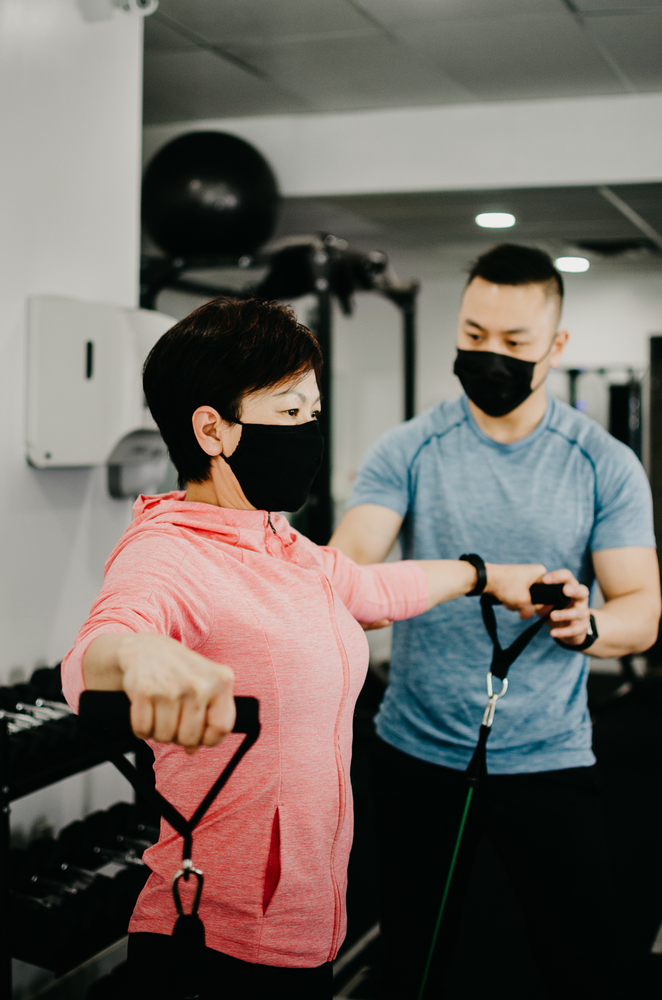
The American College of Sports Medicine (ACSM) recommends that healthy adults engage in resistance training at least twice a week for 30 minutes. They suggest working with a professional, such as a personal trainer or kinesiologist, who can tailor exercises to meet your needs and abilities if you’re just starting.
Conclusion
Exercise can certainly be intimidating with so much information out there, but keeping things simple initially by following these tips will be helpful in getting started. Be aware of your short and long-term goals and create a plan that is individualized to your own capacity and scheduling while being cautious of not doing too much too soon! Most importantly, choose something that you enjoy, and that will ultimately be the best thing for you to stay consistent! At Train with Purpose, we have a team of experienced kinesiologists and trainers to help with creating tailored exercise programs based on goals, capacity, medical history and physical assessment. If you are curious and would like to learn more, don’t be afraid to reach out! If you have any medical conditions, please gain clearance from your doctor prior to starting a new exercise program.
Leave a Reply